Morocco Discovery: Imperial Cities, Desert & the South – 17 days
This journey through Morocco provides an intensive immersion into its vibrant cities, stunning landscapes, and rich cultural heritage.
Full description
This journey through Morocco provides an intensive immersion into its vibrant cities, stunning landscapes, and rich cultural heritage. The blue-washed streets of Chefchaouen and the ancient Roman ruins of Volubilis reveal the full extent of the country’s history. And the bustling medinas of Fes and Marrakech, and the serene beauty of the Sahara Desert with camel rides and unforgettable starlit nights, leave lasting impressions
The dramatic landscapes of the Toudgha Gorges, the Dades Valley, and the Atlas Mountains invite exploration, while UNESCO sites such as Kasbah Aït ben Haddou and the peaceful Berber towns of Kalaat M’Gouna and Skoura showcase Morocco’s rural charm. These experiences offer a deep connection to the land and its people.
Throughout the journey, stays in charming riads and guesthouses provide comfort and a taste of Morocco’s renowned hospitality. Whether it is the windswept coast of Essaouira or the bustling souks of Marrakech, this adventure captures the essence of Morocco’s timeless allure.
This journey through Morocco provides an intensive immersion into its vibrant cities, stunning landscapes, and rich cultural heritage. The blue-washed streets of Chefchaouen and the ancient Roman ruins of Volubilis reveal the full extent of the country’s history. And the bustling medinas of Fes and Marrakech, and the serene beauty of the Sahara Desert with camel rides and unforgettable starlit nights, leave lasting impressions
The dramatic landscapes of the Toudgha Gorges, the Dades Valley, and the Atlas Mountains invite exploration, while UNESCO sites such as Kasbah Aït ben Haddou and the peaceful Berber towns of Kalaat M’Gouna and Skoura showcase Morocco’s rural charm. These experiences offer a deep connection to the land and its people.
Throughout the journey, stays in charming riads and guesthouses provide comfort and a taste of Morocco’s renowned hospitality. Whether it is the windswept coast of Essaouira or the bustling souks of Marrakech, this adventure captures the essence of Morocco’s timeless allure.
About this activity
17 Days
Year round
Group
Flexible group size
Morocco
Meeting point
English, Francais
Available languages
Highlights
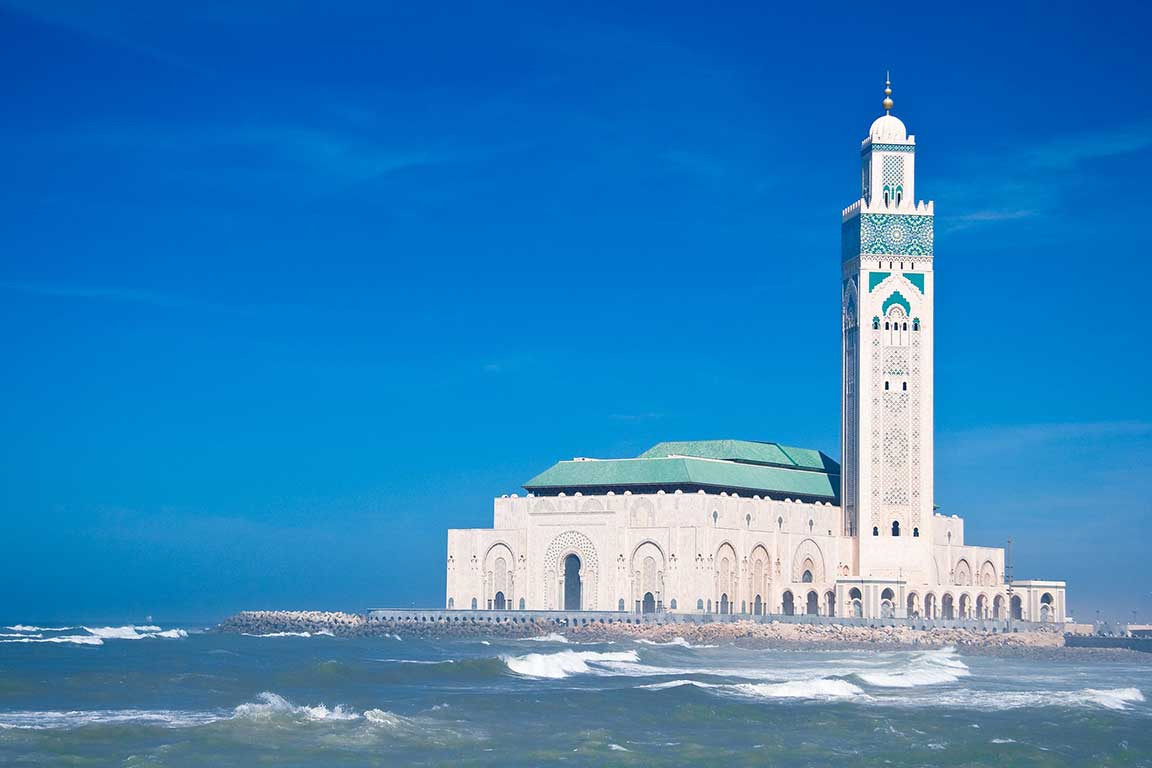
- Visiting the awe-inspiring Hassan II Mosque in Casablanca, one of the largest mosques in the world
- Exploring Rabat’s landmarks; the iconic Hassan Tower, the Mausoleum of Mohammed V & the ancient Chellah ruins
- Touring the blue-washed town of Chefchaouen and the UNESCO World Heritage Site, Roman ruins of Volubilis
- Wandering through the vibrant souks, exotic medinas, and stunning palaces and madrassahs of Fes and Marrakech
- Enjoying a camel ride through the dunes of Erg Chebbi to your luxury camp, arriving just in time for the desert sunset
- A traditional dinner under a starlit sky, followed by an evening of Berber music and drumming around the campfire
- Admiring Morocco’s famous Kasbahs, including Ksar Aït ben Haddou, as well as Telouet and Kasbah Amredhil
- Exploring the coastal charm of Essaouira, with its historic port, vibrant medina, and opportunities for surfing
What's included
What's not included
Your experience step by step
Casablanca – Rabat
Our driver will greet you at the airport in Casablanca and escort you through the beautiful Moroccan countryside to the city in an air-conditioned vehicle. Welcome to Morocco! Once in the city centre, you can visit the city’s most famous landmark: the spectacular Hassan II Mosque, the largest mosque in Africa and the tallest religious building in the world. It is remarkable for its locations being completely built over the ocean, and decorated with the most beautiful tiling and utmost craftsmanship. Due to high visitor numbers, there may be waiting times at the ticket office. The tour of the imposing building takes about one hour and tickets cost about 120 dirhams at the time of publishing. Afterwards, you will continue to the capital Rabat where you can visit the historic, fascinating and Chellah where further excavations have recently revealed very interesting historical discoveries. Built on Roman foundations, the 14th-century necropolis is one of the most unique sites in Morocco, with insights into Roman, Phoenician and Muslim history. You will spend the night in a beautiful riad at the heart of the medina. FYI: Guided tours of the Hassan II mosque are limited on Fridays or religious holidays. Please check the schedule here: Hassan II Mosque Tours and Tickets
Rabat – Chefchaouen
After a Moroccan breakfast in the riad, your first visit is scheduled to the Hassan Tower and the Mausoleum of Mohammed V, built in homage to the king who passed away in 1961. His son and successor, Hassan II, who died in 1999, is also entombed here. After lunch, your tour in Morocco continues along the motorway to Chefchaouen, turning off to reach Ouazzane and on through the mountains. Having settled in your guest house, you can spend the evening wandering the lovely streets, up and down the alleyways and relaxing in one of the many little cafés. You will spend the night in a beautiful riad.
Chefchaouen Sightseeing
Chefchaouen: the Blue Pearl of the Rif Mountains Nestled in the heart of the Rif Mountains, Chefchaouen captivates visitors with its blue and white streets and its tranquil atmosphere. The day is spent at your own pace, exploring the city’s picturesque sites or taking part in local activities. The following sites are of interest: Plaza Uta el-Hammam: This lively central square is surrounded by cafes, restaurants, and shops. The red-walled Kasbah and the Grand Mosque contribute to the vibrant scene. Chefchaouen Medina: Wandering through the narrow, blue-painted streets of the Medina offers a surreal experience. Local craft shops display handwoven textiles, pottery, and traditional souvenirs. Kasbah Museum: The museum, located within the Kasbah, provides a glimpse into local history and culture through its collection of artefacts and art. Spanish Mosque: A 30-minute walk uphill leads to the abandoned Spanish Mosque, where panoramic views of Chefchaouen and the surrounding countryside unfold. The nearby spot is a favourite for watching the sunset. Akchour Waterfalls: You could consider a day trip to the Akchour Waterfalls, about an hour away, which offers a peaceful retreat with a scenic hike through the Rif Mountains. Return to your riad for the evening after a day of exploration.
Chefchaouen – Fes
After breakfast, you will drive south to the oldest Moroccan imperial city of Fes, located in the Middle Atlas Mountains. On the way, you will be able to explore the nearby UNESCO World Heritage Site, Volubilis, the Roman ruins of the former capital of the province of Mauretania Tingitana. Founded around 25 AD under Juba II, Volubilis formed the administrative centre in the region. This World Heritage Site is the largest Roman archaeological site in Morocco with temples from the Punic-Moorish period. Looking up from this ancient setting, you can see and later visit the small hillside holy city of Moulay Idris. It is the most important place of pilgrimage in the country and houses the tomb of Moulay Idriss, the first ruler of an independent Moroccan empire and founder of the Idrisid dynasty. Non-Moslems are not permitted entry, however. The onward journey takes you through a tranquil hilly landscape past numerous farms to Fes, where you will spend the night in a riad.
Fes Sightseeing Guided Tour
A tour through Morocco’s oldest Imperial City After your licensed local guide fetches you from your riad, the day is spent discovering Fes, the oldest of Morocco’s four Imperial Cities. The tour offers the chance to explore some of the city’s most iconic attractions and gain a deeper understanding of its rich history and cultural significance. Potential Highlights: University of Al Quaraouiyine: The day might begin at the University of Al Quaraouiyine, one of the world’s oldest continuously operating educational institutions. Founded in the 9th century, it is an important part of the city’s intellectual heritage. Bou Inania Medersa: This religious school is renowned for its stunning mosaics, intricate stucco, and impressive architecture. Non-Muslim visitors are permitted to admire the splendour of Islamic artistry within its courtyard. The Royal Palace: Although the interior remains closed to the public, the exterior is a fine example of Moroccan royal architecture. A visit here offers a glimpse of the intricate design that defines this historic palace. Fes Medina: The UNESCO-listed Medina is a labyrinth of mediaeval streets. Its lively souks, ancient mosques, and historic sites provide insight into the city’s vibrant past. Leather Tanneries: Fes is famous for its centuries-old leather production. The tanneries offer an opportunity to observe traditional techniques still in use today, highlighting the city’s enduring craftsmanship. Local Markets: The markets of Fes overflow with a wide range of goods, including spices, ceramics, textiles, jewellery, and leather products, reflecting the diversity of Moroccan culture. Nejjarine Museum of Wooden Arts and Crafts: Housed in a restored caravanserai, this museum showcases fine wooden arts and crafts, celebrating the craftsmanship that has been central to Fes for generations. The day concludes with your guide accompanying you back to your riad.
Fes – Merzouga
Today’s journey takes you south over the Middle Atlas Mountains, passing through Ifrane, a town at 1665 m above sea level in the Fes-Meknes region, known for its European appearance with its sloping roofs to deal with the winter snow. Continuing via Azrou at 1278 m, known for its oak and cedar forests that provide an ideal habitat for Barbary apes, you’ll travel through Timahdite at 1800 m, in the heart of the Middle Atlas. The next significant town is Midelt, once home to Tarik Ibn Zyad, a French governor, with clear traces of its colonial past. Known as Morocco’s “apple capital,” it is surrounded by orchards and wheat fields and is famous for its Berber carpets. After lunch, the journey continues south along the N9, crossing the 2250 m Tizi-n-Talghemt Pass. This region, lined with palm trees, offers the chance to observe countless ksars (small villages). Passing through Errachidia, the route leads to Erfoud, renowned for its date festival. The nearby oases enjoy impressive fertility, and there is an opportunity to experience the lively atmosphere of the local souk, with stalls offering Berber handicrafts, fresh dates, olives, and fossils. We continue via Rissani to the famous and beautiful, red dunes of Erg Chebbi in Merzouga. From here you can take a camel ride to your camp for the night, or you can be driven to your camp if you prefer. You have dinner and spend the night at a luxury camp with a private bathroom, king-sized beds, beautiful Moroccan furnishings, and lamps tastefully arranged to enhance your enjoyment of the silence and beauty of the dunes.
Merzouga
After breakfast, you take the camels out into the dunes accompanied by a camel man. You’ll walk up to three hours in the morning, followed by about the same amount of time in the afternoon. Lunch will be with nomads at their camp in the desert and you will return to the bivouac for dinner and the night. Alternatively, after breakfast, you could see a larger part of the surrounding area. Your first stop will be the village of Khamlia, home to the Gnawa people, who specialise in traditional Gnawa music brought to the region from sub-Saharan Africa during the slave trade. They will perform some of their music for you. Next, you will visit the historic town of Rissani, the birthplace of the Alaouite dynasty, Morocco’s current ruling royal family. Rissani is surrounded by 360 ksars (fortified villages) and is known for its large souk, which takes place three times a week. Here, you can explore the market, where you’ll find a variety of goods, including spices, vegetables, household items, and handicrafts. Rissani is built on the ancient site of Sijilmassa, once the meeting point for salt caravans travelling from Timbuktu in Mali. In the afternoon, you will mount your camel and be guided by an experienced camel handler through the sand dunes of Erg Chebbi near Merzouga for about an hour to an hour and a half to enjoy the sunset. Dinner will be served at camp, followed by a night of drumming and music around the campfire. Please note that weather conditions in southern Morocco can be unpredictable. From May to the end of September, it may become too hot for trekking in the dunes, and we may recommend following this alternative itinerary instead.
Merzouga – Dades Gorges
If you wake up early enough, you can watch the spectacle of the sunrise, when the colour of the dunes and the play of shadows are an awesome sight. After breakfast at the camp, you continue your Imperial Cities Morocco tour to Tinghir and the Toudgha Gorges. On the way, you pass the water channels – “khettarat” – which you can descend into to appreciate the architecture and genius behind this form of irrigation which prevents evaporation in the summer heat. The channels start at a higher gradient at one end until they finally emerge at the surface of the soil where they are fed into the fields. (You can find out more about these channels by reading Andrew Wilson’s work). Later the itinerary continues to the Dades Valley. The area, which now forms the Dades Gorges, lay at the bottom of the sea millions of years ago. Great quantities of sediment were deposited around giant coral reefs, and over time this material became compacted into a variety of sedimentary rocks such as sandstone and limestone. Eventually, the movement of the earth’s crust caused the region to rise above the sea, forming the Atlas Mountains and surrounding landscape. The night is spent in a hotel or kasbah.
Dades Gorges – Skoura Oasis
After breakfast, the road takes you to Kasbah Aït ben Haddou, one of Morocco’s eight UNESCO World Heritage Sites, and a film location for several Hollywood blockbusters. You will explore the Kasbah with a local guide to learn about the interesting history of this most famous Kasbah in Morocco. Back in the car, you travel back through Ouarzazate and over the Tizi-n-Tinfifte pass to Agdez. Descending from the pass, you will be amazed by the vast numbers of palm trees, green oases and ancient kasbahs, all an indication of the beginning of the Dra’a Valley. A visit to Kasbah Tamnougalte, the oldest Kasbah in the Dra’a Valley is scheduled. Your journey later continues south, driving along the ancient road of the caravans as far as Zagora. The rest of the afternoon can be spent exploring this desert town. The night will be spent in a pleasant riad.
Skoura Oasis, Kasbah Aït ben Haddou, Ouarzazate – Zagora
After breakfast, the road takes you to Kasbah Aït ben Haddou, one of Morocco’s eight UNESCO World Heritage Sites, and a film location for several Hollywood blockbusters. You will explore the Kasbah with a local guide to learn about the interesting history of this most famous Kasbah in Morocco. Back in the car, you travel back through Ouarzazate and over the Tizi-n-Tinfifte pass to Agdez. Descending from the pass, you will be amazed by the vast numbers of palm trees, green oases and ancient kasbahs, all an indication of the beginning of the Dra’a Valley. A visit to Kasbah Tamnougalte, the oldest Kasbah in the Dra’a Valley is scheduled. Your journey later continues south, driving along the ancient road of the caravans as far as Zagora. The rest of the afternoon can be spent exploring this desert town. The night will be spent in a pleasant riad.
Zagora – Erg Chegaga Dunes
After breakfast, you drive to Tamegroute, a small village, where you will visit the local, green pottery co-operatives, and the famous Quranic Library. Next, you travel south driving past many Berber villages, as far as M’hamid at the end of the paved road, the gateway to the Sahara Desert. Lunch is scheduled here. In the afternoon, you set out for the Erg Chegaga Dunes, about 60 km off-track driving. The path passes different features of the desert, “erg” dunes, “hammada”, stony desert and oases. These wind-blown sand dunes are far away from civilization which makes it a great opportunity to experience moments of pure peace. After a relaxing glass of tea at the camp, enjoy a camel ride to the top of the Erg Chegaga dunes (300m), from where the sunset is spectacular. Back at the camp, dinner is served, followed by singing and nomad drumming around a campfire. You will spend the night in a luxury camp with a private bathroom, king-sized beds, beautiful Moroccan furnishings and lamps tastefully arranged to enhance your enjoyment of the silence and beauty of the dunes.
Erg Chegaga Dunes – Taroudant
After breakfast, you drive another 90 Km across the Sahara Desert through the flat stony desert. Stopping by the dry Lake Iriqui, you can hunt for fossils, some lying loosely around but most firmly fixed into the rocks. At the edge of the desert at Foum Zguid, you drive north as far as Taznakht, famous for its Berber gelims and carpets, which will be the venue for lunch. After crossing the Tizi-n-Ikhsane and Tizi-n-Tighatine passes, you arrive at Taliouine, the heart of the saffron-growing region. After lunch, you visit the local government-run museum, featuring saffron agriculture. As you enter you will notice the delicious scent of saffron. The journey continues to Taroudant, where we stop for the night in a riad.
Taroudant – Essaouira
The day begins with a visit to a town often referred to as the “little Marrakech,” renowned for its imposing ramparts and historic charm. From here, the journey follows the scenic Souss River Valley, where the landscape is adorned with argan trees and vast banana and orange plantations, stretching all the way to Agadir. The route then heads north along the coastline, passing through Taghazout, a vibrant surfing hub known for its laid-back atmosphere and stunning ocean views. As you travel alongside the Anti-Atlas Mountains, varying landscapes of rugged peaks and the Atlantic Ocean create a striking backdrop. Upon arrival in Essaouira, a coastal town famous for its artistic heritage and fortified medina, you are escorted to your riad to unwind and settle in. The evening offers the possibility of relaxing in one of the quaint cafés in the town centre, soaking in the local atmosphere and coastal breeze.
Essaouira Sightseeing
Exploring Essaouira: A Coastal Gem Essaouira, once known as Mogador during its Portuguese past, has long been a favourite among visitors. This charming seaside town offers a picturesque corniche for leisurely walks and a wide, sandy beach that stretches along the Atlantic coast. After breakfast in your riad, enjoy a full day of sightseeing in this captivating town. Stroll through the medina’s bustling markets, where narrow, winding streets are lined with shops offering a wide array of handcrafted goods. At the seafront, freshly caught fish can be selected and prepared on the spot, offering a unique and local dining experience. After lunch, the afternoon is free to explore more of the medina, take a peaceful walk along the beach, or simply relax in one of the many cafés that overlook the ocean. With excellent surfing conditions and a laid-back atmosphere, Essaouira is a haven for beach lovers and the perfect place to unwind.
Essaouira – Marrakech
After breakfast, you continue the journey by driving to Marrakech. Along the way, you pass many Berber villages, stopping perhaps at an argan oil cooperative, offering higher quality than that outside of Morocco, or even Marrakech. Argan nuts are traditionally processed by hand into one of the world’s most versatile oils, and are well-known for their culinary uses and nourishing properties for the skin. On arrival in Marrakech, you will be escorted to your riad. In the afternoon, we suggest that you visit the main square, Djemaa El Fna, to get lunch in one of the many café or restaurants which have great roof terraces overlooking the busy main square. The city is famed for this square full of juice stalls, vendors selling dried fruits and nuts, henna artists, snake charmers, storytellers, and an array of food stalls that truly come alive at night. The rest of the day can be spent exploring the square, relaxing in one of the many cafés or wandering the souks. The night spent in a beautiful riad.
Marrakech Sightseeing Guided Tour
Discover Marrakech: A Tapestry of Colour, Culture, and History Depending on your time and preferences, the following attractions can be explored: The Majorelle Gardens: Designed by French artist Jacques Majorelle and later owned by Yves Saint Laurent, these tranquil gardens feature serene fish ponds, exotic plants, and the signature “Majorelle blue” pots. The site also houses a small Berber museum, a café, and a restaurant serving Moroccan-inspired dishes. Le Jardin Secret: A restored Islamic Paradise Garden, divided into four sections by narrow water channels. The lush greenery and fountains offer a peaceful retreat, with informative displays on the garden’s reconstruction. The Koutoubia Mosque: As Marrakech’s largest mosque, the Koutoubia is an iconic landmark. Its name, “al-Koutoubiyyin,” refers to its historical connection to booksellers. Built in the Almohad style, the mosque’s 69-metre minaret is topped with four distinctive copper globes. El Bahia Palace: Built between 1894 and 1900 for the Grand Vizier Ahmed Ibn Moussa, this opulent palace boasts 160 rooms arranged around elegant courtyards. Visitors can admire intricate stucco panels, zellij tilework, tiled floors, carved cedar ceilings, and marble finishes, all set within an expansive eight-hectare garden. Ben Youssef Medersa: Once home to 800 students, this Quranic school was originally founded in 1331 by Sultan Abou el Hassan and later rebuilt by the Saadians in the 1560s. Its striking architecture features detailed zellij tiling, stucco plasterwork, and intricately carved cedar wood. The Saadian Tombs: Dating back to the reign of Sultan Ahmad al-Mansur (1578–1603) and rediscovered in 1917, these tombs serve as the final resting place for around sixty members of the Saadi Dynasty and are an important historical site. The Jewish Mellah: Like many Moroccan cities, Marrakech has a historic Jewish quarter known as the Mellah. While it was once home to non-Muslim communities, today few synagogues remain in use, though many still stand as a testament to the city’s diverse heritage. The Souks: Marrakech’s vibrant souks form the heart of the city, offering everything from handicrafts, spices, and traditional medicines to Moroccan slippers (babouches), leather goods, textiles, pottery, and silver jewellery. The bustling markets provide endless opportunities to haggle and find unique souvenirs. With its rich history, vibrant culture, and stunning architecture, Marrakech feels like a city straight out of “A Thousand and One Nights.” FYI: You can buy entry tickets at each monument, but Majorelle Garden tickets must be booked online in advance. Tip: For those interested, a traditional Moroccan cooking class can be arranged instead of a city tour, which is available for an additional fee. The night will be spent in a riad.
Marrakech – Transfer to the airport in Marrakech or Casablanca
After breakfast in your riad, and depending on the time of your flight, you will be transferred by your driver to the airport to catch your flight on time.
Casablanca – Rabat
Our driver will greet you at the airport in Casablanca and escort you through the beautiful Moroccan countryside to the city in an air-conditioned vehicle. Welcome to Morocco! Once in the city centre, you can visit the city’s most famous landmark: the spectacular Hassan II Mosque, the largest mosque in Africa and the tallest religious building in the world. It is remarkable for its locations being completely built over the ocean, and decorated with the most beautiful tiling and utmost craftsmanship. Due to high visitor numbers, there may be waiting times at the ticket office. The tour of the imposing building takes about one hour and tickets cost about 120 dirhams at the time of publishing. Afterwards, you will continue to the capital Rabat where you can visit the historic, fascinating and Chellah where further excavations have recently revealed very interesting historical discoveries. Built on Roman foundations, the 14th-century necropolis is one of the most unique sites in Morocco, with insights into Roman, Phoenician and Muslim history. You will spend the night in a beautiful riad at the heart of the medina. FYI: Guided tours of the Hassan II mosque are limited on Fridays or religious holidays. Please check the schedule here: Hassan II Mosque Tours and Tickets
Rabat – Chefchaouen
After a Moroccan breakfast in the riad, your first visit is scheduled to the Hassan Tower and the Mausoleum of Mohammed V, built in homage to the king who passed away in 1961. His son and successor, Hassan II, who died in 1999, is also entombed here. After lunch, your tour in Morocco continues along the motorway to Chefchaouen, turning off to reach Ouazzane and on through the mountains. Having settled in your guest house, you can spend the evening wandering the lovely streets, up and down the alleyways and relaxing in one of the many little cafés. You will spend the night in a beautiful riad.
Chefchaouen Sightseeing
Chefchaouen: the Blue Pearl of the Rif Mountains Nestled in the heart of the Rif Mountains, Chefchaouen captivates visitors with its blue and white streets and its tranquil atmosphere. The day is spent at your own pace, exploring the city’s picturesque sites or taking part in local activities. The following sites are of interest: Plaza Uta el-Hammam: This lively central square is surrounded by cafes, restaurants, and shops. The red-walled Kasbah and the Grand Mosque contribute to the vibrant scene. Chefchaouen Medina: Wandering through the narrow, blue-painted streets of the Medina offers a surreal experience. Local craft shops display handwoven textiles, pottery, and traditional souvenirs. Kasbah Museum: The museum, located within the Kasbah, provides a glimpse into local history and culture through its collection of artefacts and art. Spanish Mosque: A 30-minute walk uphill leads to the abandoned Spanish Mosque, where panoramic views of Chefchaouen and the surrounding countryside unfold. The nearby spot is a favourite for watching the sunset. Akchour Waterfalls: You could consider a day trip to the Akchour Waterfalls, about an hour away, which offers a peaceful retreat with a scenic hike through the Rif Mountains. Return to your riad for the evening after a day of exploration.
Chefchaouen – Fes
After breakfast, you will drive south to the oldest Moroccan imperial city of Fes, located in the Middle Atlas Mountains. On the way, you will be able to explore the nearby UNESCO World Heritage Site, Volubilis, the Roman ruins of the former capital of the province of Mauretania Tingitana. Founded around 25 AD under Juba II, Volubilis formed the administrative centre in the region. This World Heritage Site is the largest Roman archaeological site in Morocco with temples from the Punic-Moorish period. Looking up from this ancient setting, you can see and later visit the small hillside holy city of Moulay Idris. It is the most important place of pilgrimage in the country and houses the tomb of Moulay Idriss, the first ruler of an independent Moroccan empire and founder of the Idrisid dynasty. Non-Moslems are not permitted entry, however. The onward journey takes you through a tranquil hilly landscape past numerous farms to Fes, where you will spend the night in a riad.
Fes Sightseeing Guided Tour
A tour through Morocco’s oldest Imperial City After your licensed local guide fetches you from your riad, the day is spent discovering Fes, the oldest of Morocco’s four Imperial Cities. The tour offers the chance to explore some of the city’s most iconic attractions and gain a deeper understanding of its rich history and cultural significance. Potential Highlights: University of Al Quaraouiyine: The day might begin at the University of Al Quaraouiyine, one of the world’s oldest continuously operating educational institutions. Founded in the 9th century, it is an important part of the city’s intellectual heritage. Bou Inania Medersa: This religious school is renowned for its stunning mosaics, intricate stucco, and impressive architecture. Non-Muslim visitors are permitted to admire the splendour of Islamic artistry within its courtyard. The Royal Palace: Although the interior remains closed to the public, the exterior is a fine example of Moroccan royal architecture. A visit here offers a glimpse of the intricate design that defines this historic palace. Fes Medina: The UNESCO-listed Medina is a labyrinth of mediaeval streets. Its lively souks, ancient mosques, and historic sites provide insight into the city’s vibrant past. Leather Tanneries: Fes is famous for its centuries-old leather production. The tanneries offer an opportunity to observe traditional techniques still in use today, highlighting the city’s enduring craftsmanship. Local Markets: The markets of Fes overflow with a wide range of goods, including spices, ceramics, textiles, jewellery, and leather products, reflecting the diversity of Moroccan culture. Nejjarine Museum of Wooden Arts and Crafts: Housed in a restored caravanserai, this museum showcases fine wooden arts and crafts, celebrating the craftsmanship that has been central to Fes for generations. The day concludes with your guide accompanying you back to your riad.
Fes – Merzouga
Today’s journey takes you south over the Middle Atlas Mountains, passing through Ifrane, a town at 1665 m above sea level in the Fes-Meknes region, known for its European appearance with its sloping roofs to deal with the winter snow. Continuing via Azrou at 1278 m, known for its oak and cedar forests that provide an ideal habitat for Barbary apes, you’ll travel through Timahdite at 1800 m, in the heart of the Middle Atlas. The next significant town is Midelt, once home to Tarik Ibn Zyad, a French governor, with clear traces of its colonial past. Known as Morocco’s “apple capital,” it is surrounded by orchards and wheat fields and is famous for its Berber carpets. After lunch, the journey continues south along the N9, crossing the 2250 m Tizi-n-Talghemt Pass. This region, lined with palm trees, offers the chance to observe countless ksars (small villages). Passing through Errachidia, the route leads to Erfoud, renowned for its date festival. The nearby oases enjoy impressive fertility, and there is an opportunity to experience the lively atmosphere of the local souk, with stalls offering Berber handicrafts, fresh dates, olives, and fossils. We continue via Rissani to the famous and beautiful, red dunes of Erg Chebbi in Merzouga. From here you can take a camel ride to your camp for the night, or you can be driven to your camp if you prefer. You have dinner and spend the night at a luxury camp with a private bathroom, king-sized beds, beautiful Moroccan furnishings, and lamps tastefully arranged to enhance your enjoyment of the silence and beauty of the dunes.
Merzouga
After breakfast, you take the camels out into the dunes accompanied by a camel man. You’ll walk up to three hours in the morning, followed by about the same amount of time in the afternoon. Lunch will be with nomads at their camp in the desert and you will return to the bivouac for dinner and the night. Alternatively, after breakfast, you could see a larger part of the surrounding area. Your first stop will be the village of Khamlia, home to the Gnawa people, who specialise in traditional Gnawa music brought to the region from sub-Saharan Africa during the slave trade. They will perform some of their music for you. Next, you will visit the historic town of Rissani, the birthplace of the Alaouite dynasty, Morocco’s current ruling royal family. Rissani is surrounded by 360 ksars (fortified villages) and is known for its large souk, which takes place three times a week. Here, you can explore the market, where you’ll find a variety of goods, including spices, vegetables, household items, and handicrafts. Rissani is built on the ancient site of Sijilmassa, once the meeting point for salt caravans travelling from Timbuktu in Mali. In the afternoon, you will mount your camel and be guided by an experienced camel handler through the sand dunes of Erg Chebbi near Merzouga for about an hour to an hour and a half to enjoy the sunset. Dinner will be served at camp, followed by a night of drumming and music around the campfire. Please note that weather conditions in southern Morocco can be unpredictable. From May to the end of September, it may become too hot for trekking in the dunes, and we may recommend following this alternative itinerary instead.
Merzouga – Dades Gorges
If you wake up early enough, you can watch the spectacle of the sunrise, when the colour of the dunes and the play of shadows are an awesome sight. After breakfast at the camp, you continue your Imperial Cities Morocco tour to Tinghir and the Toudgha Gorges. On the way, you pass the water channels – “khettarat” – which you can descend into to appreciate the architecture and genius behind this form of irrigation which prevents evaporation in the summer heat. The channels start at a higher gradient at one end until they finally emerge at the surface of the soil where they are fed into the fields. (You can find out more about these channels by reading Andrew Wilson’s work). Later the itinerary continues to the Dades Valley. The area, which now forms the Dades Gorges, lay at the bottom of the sea millions of years ago. Great quantities of sediment were deposited around giant coral reefs, and over time this material became compacted into a variety of sedimentary rocks such as sandstone and limestone. Eventually, the movement of the earth’s crust caused the region to rise above the sea, forming the Atlas Mountains and surrounding landscape. The night is spent in a hotel or kasbah.
Dades Gorges – Skoura Oasis
After breakfast, the road takes you to Kasbah Aït ben Haddou, one of Morocco’s eight UNESCO World Heritage Sites, and a film location for several Hollywood blockbusters. You will explore the Kasbah with a local guide to learn about the interesting history of this most famous Kasbah in Morocco. Back in the car, you travel back through Ouarzazate and over the Tizi-n-Tinfifte pass to Agdez. Descending from the pass, you will be amazed by the vast numbers of palm trees, green oases and ancient kasbahs, all an indication of the beginning of the Dra’a Valley. A visit to Kasbah Tamnougalte, the oldest Kasbah in the Dra’a Valley is scheduled. Your journey later continues south, driving along the ancient road of the caravans as far as Zagora. The rest of the afternoon can be spent exploring this desert town. The night will be spent in a pleasant riad.
Skoura Oasis, Kasbah Aït ben Haddou, Ouarzazate – Zagora
After breakfast, the road takes you to Kasbah Aït ben Haddou, one of Morocco’s eight UNESCO World Heritage Sites, and a film location for several Hollywood blockbusters. You will explore the Kasbah with a local guide to learn about the interesting history of this most famous Kasbah in Morocco. Back in the car, you travel back through Ouarzazate and over the Tizi-n-Tinfifte pass to Agdez. Descending from the pass, you will be amazed by the vast numbers of palm trees, green oases and ancient kasbahs, all an indication of the beginning of the Dra’a Valley. A visit to Kasbah Tamnougalte, the oldest Kasbah in the Dra’a Valley is scheduled. Your journey later continues south, driving along the ancient road of the caravans as far as Zagora. The rest of the afternoon can be spent exploring this desert town. The night will be spent in a pleasant riad.
Zagora – Erg Chegaga Dunes
After breakfast, you drive to Tamegroute, a small village, where you will visit the local, green pottery co-operatives, and the famous Quranic Library. Next, you travel south driving past many Berber villages, as far as M’hamid at the end of the paved road, the gateway to the Sahara Desert. Lunch is scheduled here. In the afternoon, you set out for the Erg Chegaga Dunes, about 60 km off-track driving. The path passes different features of the desert, “erg” dunes, “hammada”, stony desert and oases. These wind-blown sand dunes are far away from civilization which makes it a great opportunity to experience moments of pure peace. After a relaxing glass of tea at the camp, enjoy a camel ride to the top of the Erg Chegaga dunes (300m), from where the sunset is spectacular. Back at the camp, dinner is served, followed by singing and nomad drumming around a campfire. You will spend the night in a luxury camp with a private bathroom, king-sized beds, beautiful Moroccan furnishings and lamps tastefully arranged to enhance your enjoyment of the silence and beauty of the dunes.
Erg Chegaga Dunes – Taroudant
After breakfast, you drive another 90 Km across the Sahara Desert through the flat stony desert. Stopping by the dry Lake Iriqui, you can hunt for fossils, some lying loosely around but most firmly fixed into the rocks. At the edge of the desert at Foum Zguid, you drive north as far as Taznakht, famous for its Berber gelims and carpets, which will be the venue for lunch. After crossing the Tizi-n-Ikhsane and Tizi-n-Tighatine passes, you arrive at Taliouine, the heart of the saffron-growing region. After lunch, you visit the local government-run museum, featuring saffron agriculture. As you enter you will notice the delicious scent of saffron. The journey continues to Taroudant, where we stop for the night in a riad.
Taroudant – Essaouira
The day begins with a visit to a town often referred to as the “little Marrakech,” renowned for its imposing ramparts and historic charm. From here, the journey follows the scenic Souss River Valley, where the landscape is adorned with argan trees and vast banana and orange plantations, stretching all the way to Agadir. The route then heads north along the coastline, passing through Taghazout, a vibrant surfing hub known for its laid-back atmosphere and stunning ocean views. As you travel alongside the Anti-Atlas Mountains, varying landscapes of rugged peaks and the Atlantic Ocean create a striking backdrop. Upon arrival in Essaouira, a coastal town famous for its artistic heritage and fortified medina, you are escorted to your riad to unwind and settle in. The evening offers the possibility of relaxing in one of the quaint cafés in the town centre, soaking in the local atmosphere and coastal breeze.
Essaouira Sightseeing
Exploring Essaouira: A Coastal Gem Essaouira, once known as Mogador during its Portuguese past, has long been a favourite among visitors. This charming seaside town offers a picturesque corniche for leisurely walks and a wide, sandy beach that stretches along the Atlantic coast. After breakfast in your riad, enjoy a full day of sightseeing in this captivating town. Stroll through the medina’s bustling markets, where narrow, winding streets are lined with shops offering a wide array of handcrafted goods. At the seafront, freshly caught fish can be selected and prepared on the spot, offering a unique and local dining experience. After lunch, the afternoon is free to explore more of the medina, take a peaceful walk along the beach, or simply relax in one of the many cafés that overlook the ocean. With excellent surfing conditions and a laid-back atmosphere, Essaouira is a haven for beach lovers and the perfect place to unwind.
Essaouira – Marrakech
After breakfast, you continue the journey by driving to Marrakech. Along the way, you pass many Berber villages, stopping perhaps at an argan oil cooperative, offering higher quality than that outside of Morocco, or even Marrakech. Argan nuts are traditionally processed by hand into one of the world’s most versatile oils, and are well-known for their culinary uses and nourishing properties for the skin. On arrival in Marrakech, you will be escorted to your riad. In the afternoon, we suggest that you visit the main square, Djemaa El Fna, to get lunch in one of the many café or restaurants which have great roof terraces overlooking the busy main square. The city is famed for this square full of juice stalls, vendors selling dried fruits and nuts, henna artists, snake charmers, storytellers, and an array of food stalls that truly come alive at night. The rest of the day can be spent exploring the square, relaxing in one of the many cafés or wandering the souks. The night spent in a beautiful riad.
Marrakech Sightseeing Guided Tour
Discover Marrakech: A Tapestry of Colour, Culture, and History Depending on your time and preferences, the following attractions can be explored: The Majorelle Gardens: Designed by French artist Jacques Majorelle and later owned by Yves Saint Laurent, these tranquil gardens feature serene fish ponds, exotic plants, and the signature “Majorelle blue” pots. The site also houses a small Berber museum, a café, and a restaurant serving Moroccan-inspired dishes. Le Jardin Secret: A restored Islamic Paradise Garden, divided into four sections by narrow water channels. The lush greenery and fountains offer a peaceful retreat, with informative displays on the garden’s reconstruction. The Koutoubia Mosque: As Marrakech’s largest mosque, the Koutoubia is an iconic landmark. Its name, “al-Koutoubiyyin,” refers to its historical connection to booksellers. Built in the Almohad style, the mosque’s 69-metre minaret is topped with four distinctive copper globes. El Bahia Palace: Built between 1894 and 1900 for the Grand Vizier Ahmed Ibn Moussa, this opulent palace boasts 160 rooms arranged around elegant courtyards. Visitors can admire intricate stucco panels, zellij tilework, tiled floors, carved cedar ceilings, and marble finishes, all set within an expansive eight-hectare garden. Ben Youssef Medersa: Once home to 800 students, this Quranic school was originally founded in 1331 by Sultan Abou el Hassan and later rebuilt by the Saadians in the 1560s. Its striking architecture features detailed zellij tiling, stucco plasterwork, and intricately carved cedar wood. The Saadian Tombs: Dating back to the reign of Sultan Ahmad al-Mansur (1578–1603) and rediscovered in 1917, these tombs serve as the final resting place for around sixty members of the Saadi Dynasty and are an important historical site. The Jewish Mellah: Like many Moroccan cities, Marrakech has a historic Jewish quarter known as the Mellah. While it was once home to non-Muslim communities, today few synagogues remain in use, though many still stand as a testament to the city’s diverse heritage. The Souks: Marrakech’s vibrant souks form the heart of the city, offering everything from handicrafts, spices, and traditional medicines to Moroccan slippers (babouches), leather goods, textiles, pottery, and silver jewellery. The bustling markets provide endless opportunities to haggle and find unique souvenirs. With its rich history, vibrant culture, and stunning architecture, Marrakech feels like a city straight out of “A Thousand and One Nights.” FYI: You can buy entry tickets at each monument, but Majorelle Garden tickets must be booked online in advance. Tip: For those interested, a traditional Moroccan cooking class can be arranged instead of a city tour, which is available for an additional fee. The night will be spent in a riad.
Marrakech – Transfer to the airport in Marrakech or Casablanca
After breakfast in your riad, and depending on the time of your flight, you will be transferred by your driver to the airport to catch your flight on time.
What to bring
- •Guided tours of the Hassan II mosque are limited on Fridays or religious holidays. Please check the schedule here: Hassan II Mosque Tours and Tickets
- •You can buy entry tickets at each monument during your guided tour of Marrakech, but Majorelle Garden tickets must be booked online in advance.
- •According to weather conditions from the end of May to the end of September, it may be necessary to take the alternative for the second day in the dunes
- •This Morocco desert tour from Casablanca can be customised to be more special and personal
- •It is possible to choose to start and/or end this tour in Marrakech instead
- •You can always consult your driver about skipping some places to spend more time elsewhere
- •Here is a downloadable packing list to help plan for your Moroccan desert tour
- •We require a 30% deposit of the total price to book the car, while the balance is payable to us in the office in Ouarzazate
- •We accept payment through PayPal, bank transfers in Europe, by credit card, or cash (USD, Euro, GBP, or MAD)
- •We offer a 25% discount for children under 12, and one child under 3 per family travels free of charge
- •These prices are liable to fluctuation according to the current exchange rate
- •Our prices can be subject to an increase over the busy season, and, in particular, the Christmas and New Year’s Eve period
- •Guided tours of the Hassan II mosque are limited on Fridays or religious holidays. Please check the schedule here: Hassan II Mosque Tours and Tickets
- •You can buy entry tickets at each monument during your guided tour of Marrakech, but Majorelle Garden tickets must be booked online in advance.
- •According to weather conditions from the end of May to the end of September, it may be necessary to take the alternative for the second day in the dunes
- •This Morocco desert tour from Casablanca can be customised to be more special and personal
- •It is possible to choose to start and/or end this tour in Marrakech instead
- •You can always consult your driver about skipping some places to spend more time elsewhere
- •Here is a downloadable packing list to help plan for your Moroccan desert tour
- •We require a 30% deposit of the total price to book the car, while the balance is payable to us in the office in Ouarzazate
- •We accept payment through PayPal, bank transfers in Europe, by credit card, or cash (USD, Euro, GBP, or MAD)
- •We offer a 25% discount for children under 12, and one child under 3 per family travels free of charge
- •These prices are liable to fluctuation according to the current exchange rate
- •Our prices can be subject to an increase over the busy season, and, in particular, the Christmas and New Year’s Eve period