Grand Desert Tour of the Moroccan South – 7 days
Perhaps your prime reason for visiting Morocco is to visit the spellbinding largest desert in the world – the Sahara.
Full description
Perhaps your prime reason for visiting Morocco is to visit the spellbinding largest desert in the world – the Sahara. On this 7-day desert tour of South Morocco, combining the famous Erg Chebbi dunes in Merzouga and the remote dunes of Erg Chegaga, you will have a leisurely opportunity to achieve this goal.
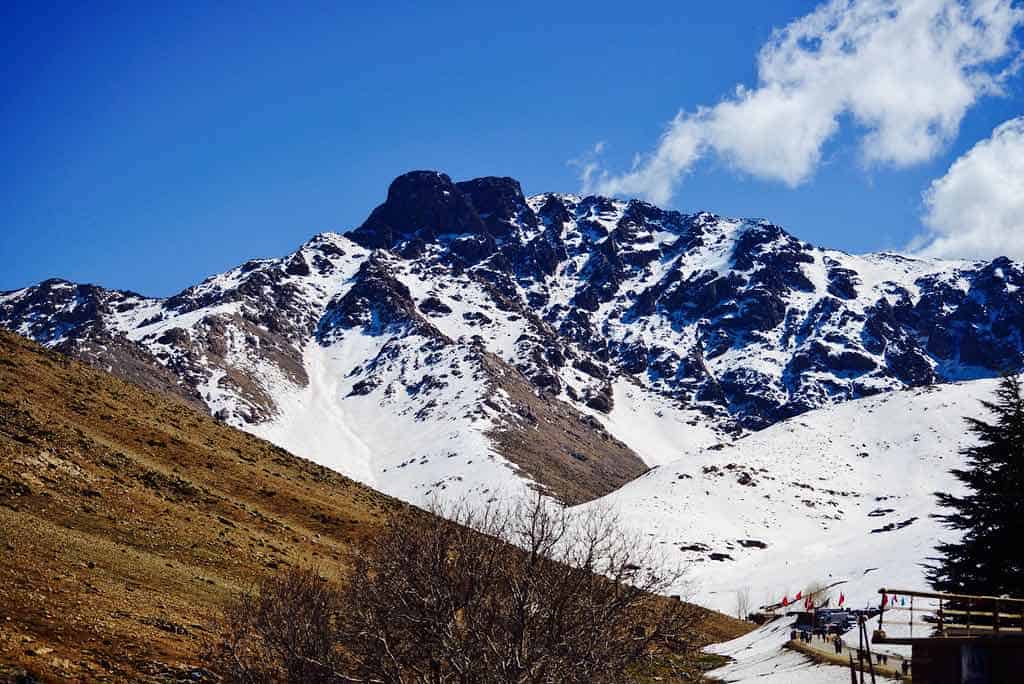
This tour from Marrakech provides you with a scenic drive over the majestic High Atlas Mountains past Berber adobe housing in the villages and Kasbahs: Telouet, Aït ben Haddou, Amredhil in Skoura and in the Dra’a Valley.
Pre-historic geology is visible round every bend and the fossil artefact exhibits in Erfoud quite other-wordly. In the timeless Sahara Desert, you have your own private and comfortable luxury desert tent after your camel ride. Here there is time to absorb the calm, peacefulness, and above all the immense silence.
Other pleasures are the rose products in the Rose Valley, the potteries and Qoranic Library with its exquisite manuscripts in Tamgroute, fossil hunting at Lake Iriqui, and Berber rug and carpet co-operatives in Taznakht, the Atlas Film Studios in Ouarzazate
By the time you reach Marrakech at the end of the desert tour your head will be bursting with impressions, experiences and images never to be forgotten.
Perhaps your prime reason for visiting Morocco is to visit the spellbinding largest desert in the world – the Sahara. On this 7-day desert tour of South Morocco, combining the famous Erg Chebbi dunes in Merzouga and the remote dunes of Erg Chegaga, you will have a leisurely opportunity to achieve this goal.
This tour from Marrakech provides you with a scenic drive over the majestic High Atlas Mountains past Berber adobe housing in the villages and Kasbahs: Telouet, Aït ben Haddou, Amredhil in Skoura and in the Dra’a Valley.
Pre-historic geology is visible round every bend and the fossil artefact exhibits in Erfoud quite other-wordly. In the timeless Sahara Desert, you have your own private and comfortable luxury desert tent after your camel ride. Here there is time to absorb the calm, peacefulness, and above all the immense silence.
Other pleasures are the rose products in the Rose Valley, the potteries and Qoranic Library with its exquisite manuscripts in Tamgroute, fossil hunting at Lake Iriqui, and Berber rug and carpet co-operatives in Taznakht, the Atlas Film Studios in Ouarzazate
By the time you reach Marrakech at the end of the desert tour your head will be bursting with impressions, experiences and images never to be forgotten.
About this activity
7 Days
Year round
Group
Max 15 people
Morocco
Meeting point
English, Francais
Available languages
Highlights
- Visiting the famous Kasbahs of Telouet, Ait Ben Haddou, and Amredhil in Skoura
- Stopping at the cosmetic co-operatives in Kela’a M’gouna in the Rose Valley
- Discovering the pottery workshops and kilns, and the Qoranic library in Tamgroute
- Spending the night in a luxury desert camps in Erg Chebbi and Erg Chegaga
- Taking a camel ride to camp from where you will watch the dramatic sunset
- Gazing at starlit skies followed by evenings of Berber and nomad music
- Searching for fossils at Lake Iriqi and viewing Berber rug crafts in Taznakht
- Wandering round the Atlas Film Studios at the entrance to Ouarzazate
What's included
What's not included
Your experience step by step
Marrakech – Skoura
Your morning departure from your hotel/riad in Marrakech will be at 08.30. As you cross the High Atlas Mountains, there will be plenty of opportunities for taking photos at various panoramic viewpoints. The first scheduled stop is at the Kasbah of Telouet, which served as a palatial residence and the headquarters of the powerful Glaoui family. Their wealth stemmed partially from the now disused salt mines just outside the village. The three main buildings, two of which are now too dangerous to enter, are in ruins but once housed harems, concubines and slaves. Unfortunately, the whole Kasbah is now closed due to the damage caused by the earthquake that struck Morocco in September 2023. Nevertheless, it is still worth visiting the exterior with a local guide to discover its rich history. The route leads south down the beautiful Ounila Valley. With its fertile fields and gardens along the riverbed far below the road, it offers a perfect insight into the characteristic Berber life of all these local valleys. Olives, almonds and fruit trees are the main crops and vital to many families. As you follow the river, you come to the Kasbah of Aït ben Haddou, the oldest and most famous Kasbah in Morocco, and one of Morocco’s nine UNESCO World Heritage sites. The architectural style is well preserved and the earthen constructions are perfectly adapted to the climatic conditions in harmony with the natural and social environment. Probably originating in the 17th century, it has also become famous as the backdrop to a great many Hollywood blockbuster films. After passing through Ouarzazate and coming to the office to pay the balance, you continue to Skoura Oasis for the night there.
Skoura – Dades Gorges
After breakfast, you will visit the fascinating museum and ancient multi-generational home of Kasbah Amredhil. It has been beautifully restored and gives a clear idea of life of how families lived together in one large building. Like all other Kasbahs, it is made entirely of adobe, an excellent building material of loam and straw; warm in winter and cool in summer, thanks to the thick walls. From here, our route takes us through Kela’a M’gouna, the Valley of Roses, which is famous for its Rose Festival in May. The cosmetic articles made locally from the valley’s abundant flowers are well-known throughout Morocco and are highly valued, so rose-scented toiletries are on sale if you are keen! From the town centre the road passes various villages and then turns off-road. This gives you a deeper insight into the barren rocky landscape away from the river and along the mountains. Part way along, you will stop at caves for a glass of tea with the Berber nomads whose family has been in residence there for generations. You continue to the Dades Valley for lunch and a visit to the gorge. This leaves you half a day to walk in the valley, to spend it relaxing or simply strolling by the fields and gardens. If you wish, you could hike into the mountains to spend that night with a local Berber family.
Dades Gorges – Merzouga
After breakfast, the trip continues a short way to the mining town of Tinghir and the very different Toudgha gorges. A short walk through the gorge is possible to appreciate the steep sides and the narrow expanse of the sky above. It is, however, very touristy as the tour buses can enter the gorge. On the other side of Tinjdad, you pass underground water channels – “khettarat” – which you can descend into to appreciate the architecture and genius behind this form of irrigation. The channels start at a higher gradient at one end until they finally emerge at the surface of the soil where they are fed into the fields with minimal evaporation. Even in the heat of high summer, it remains really cool underground. You can find out more about these channels by reading Andrew Wilson’s work. You continue to the Oasis of Tafilalet near Erfoud, famous for its Date Festival in November. In the townitself, you can stop to see the workings of thousands of fossils made into all sorts of artefacts. Later you reach Rissani, the seat of the Alaouite family of the present king of Morocco. From the edge of the desert, you take a camel ride to reach the camp before walking up into the dunes to watch the sunset. You have dinner and spend the night at a luxury camp with private bathroom, king-sized beds, beautiful Moroccan furnishings and lamps tastefully arranged to enhance your enjoyment of the silence and beauty of the dunes.
Merzouga – Agdez
If you wake up early enough, you can watch the slow sunrise. The colour of the shadows on the sand of the near side of the dunes is unique in the day. The drive west to the Dra’a Valley takes us via the villages of Tazzarine (which is briefly featured in the film ‘Babel’) and N’Qob, where you stop to have lunch. In the afternoon, we continue to Tansikht, at which point we cross the Dra’a River. Just after the turn right, do ask your driver to stop to wonder at the massive dinosaur footprints in the rock right beside the road. We continue a short way north up this part of the Dra’a valley, full of palm trees of some 44 date varieties, as far as Agdez at the head of the valley to spend the night.
Agdez – Chegaga Dunes
After breakfast, there is an opportunity to visit KasbahTamnougalte, the oldest and largest in the Dra’a Valley. Parts of it are still inhabited but other parts slowly crumbling away. For a short while, we go off-road along some of the ancient Saharan caravan route running between the mountains and the Dra’a River, passing villages and gardens. You will be able to gain a better idea of oasis life and means of existence. Back at Tanskiht, you continue down the valley to Tinsouline, from where you can drive just a kilometre or so off-road to Foum Chenna. Here some fascinating rock carvings, some 4000 years old, of animals long since extinct in Morocco. Having passed Zagora, the largest town in the whole area, we stop in Tamgroute. The potteries here are run by four families and produce the famous green glaze, which you may have already seen in Marrakech and certainly all over the south. The village is also home to the ancient and well-known Quranic School and its library of exquisite hand-written Arabic texts. Further south still we come to M’hamid, the very gate to the desert and the end of the asphalted road. This is where the vast Sahara starts, never-ending until Egypt. The final part of today’s itinerary is 60 km across the desert to the Erg Chegaga dunes (300m). These remote dunes are far from civilisation and only home to a few remaining nomadic families. Here, the quiet and the extent of the sand dunes are quite overwhelming. Dinner and the night are once again at a luxury camp with private bathroom, king-sized beds, beautiful Moroccan furnishings and lamps tastefully arranged to enhance your enjoyment of the silence and beauty of the dunes.
Chegaga Dunes – Ouarzazate
After breakfast, the road takes us through another 90km of desert with varying scenery: Lake Iriqui, the mountains in the distance and fossils by the side of the lake. Foum Zguid is the first village after the desert, and you will probably welcome a stop for a coffee or tea whilst the driver may make the most of the time to remove all the sand from the car’s filter. The drive back north is along paved roads via the village of Taznakht, famous for its Berber carpets and rugs. You are welcome to stop here to see the weaving and the large number of designs used. It is also possible that you will have lunch here. From Taznakht the road goes eastwards to reach the main Marrakech to Ouarzazate road. Turning right, you return to Ouarzazate for the night in a riad.
Ouarzazate – Marrakech
After breakfast we make a morning visit to Kasbah Taourirt, which is also a Glaoui Kasbah and the notable landmark of Ouarzazate. Not far from the town lie the cinema studios, well-worth a visit for Hollywood blockbuster film buffs to see many of the original sets used in the filming. Kasbah Tifoultoute lies a little of the main road and is perched on an outcrop overlooking the valley and the river, above the village which is greatly expanding in size. We drive much of the way back along a different road to Marrakech, which once again passes numerous Berber villages, fields and gardens, where walnut, apples, quince and pomegranate trees alongside silver birch and oleander are visible everywhere. At the end of the afternoon, having crossed the Tizi-n-Tichka pass, we arrive in Marrakech. Your driver escorts you to your hotel bringing your desert tour of Southern Morocco to an end.
Marrakech – Skoura
Your morning departure from your hotel/riad in Marrakech will be at 08.30. As you cross the High Atlas Mountains, there will be plenty of opportunities for taking photos at various panoramic viewpoints. The first scheduled stop is at the Kasbah of Telouet, which served as a palatial residence and the headquarters of the powerful Glaoui family. Their wealth stemmed partially from the now disused salt mines just outside the village. The three main buildings, two of which are now too dangerous to enter, are in ruins but once housed harems, concubines and slaves. Unfortunately, the whole Kasbah is now closed due to the damage caused by the earthquake that struck Morocco in September 2023. Nevertheless, it is still worth visiting the exterior with a local guide to discover its rich history. The route leads south down the beautiful Ounila Valley. With its fertile fields and gardens along the riverbed far below the road, it offers a perfect insight into the characteristic Berber life of all these local valleys. Olives, almonds and fruit trees are the main crops and vital to many families. As you follow the river, you come to the Kasbah of Aït ben Haddou, the oldest and most famous Kasbah in Morocco, and one of Morocco’s nine UNESCO World Heritage sites. The architectural style is well preserved and the earthen constructions are perfectly adapted to the climatic conditions in harmony with the natural and social environment. Probably originating in the 17th century, it has also become famous as the backdrop to a great many Hollywood blockbuster films. After passing through Ouarzazate and coming to the office to pay the balance, you continue to Skoura Oasis for the night there.
Skoura – Dades Gorges
After breakfast, you will visit the fascinating museum and ancient multi-generational home of Kasbah Amredhil. It has been beautifully restored and gives a clear idea of life of how families lived together in one large building. Like all other Kasbahs, it is made entirely of adobe, an excellent building material of loam and straw; warm in winter and cool in summer, thanks to the thick walls. From here, our route takes us through Kela’a M’gouna, the Valley of Roses, which is famous for its Rose Festival in May. The cosmetic articles made locally from the valley’s abundant flowers are well-known throughout Morocco and are highly valued, so rose-scented toiletries are on sale if you are keen! From the town centre the road passes various villages and then turns off-road. This gives you a deeper insight into the barren rocky landscape away from the river and along the mountains. Part way along, you will stop at caves for a glass of tea with the Berber nomads whose family has been in residence there for generations. You continue to the Dades Valley for lunch and a visit to the gorge. This leaves you half a day to walk in the valley, to spend it relaxing or simply strolling by the fields and gardens. If you wish, you could hike into the mountains to spend that night with a local Berber family.
Dades Gorges – Merzouga
After breakfast, the trip continues a short way to the mining town of Tinghir and the very different Toudgha gorges. A short walk through the gorge is possible to appreciate the steep sides and the narrow expanse of the sky above. It is, however, very touristy as the tour buses can enter the gorge. On the other side of Tinjdad, you pass underground water channels – “khettarat” – which you can descend into to appreciate the architecture and genius behind this form of irrigation. The channels start at a higher gradient at one end until they finally emerge at the surface of the soil where they are fed into the fields with minimal evaporation. Even in the heat of high summer, it remains really cool underground. You can find out more about these channels by reading Andrew Wilson’s work. You continue to the Oasis of Tafilalet near Erfoud, famous for its Date Festival in November. In the townitself, you can stop to see the workings of thousands of fossils made into all sorts of artefacts. Later you reach Rissani, the seat of the Alaouite family of the present king of Morocco. From the edge of the desert, you take a camel ride to reach the camp before walking up into the dunes to watch the sunset. You have dinner and spend the night at a luxury camp with private bathroom, king-sized beds, beautiful Moroccan furnishings and lamps tastefully arranged to enhance your enjoyment of the silence and beauty of the dunes.
Merzouga – Agdez
If you wake up early enough, you can watch the slow sunrise. The colour of the shadows on the sand of the near side of the dunes is unique in the day. The drive west to the Dra’a Valley takes us via the villages of Tazzarine (which is briefly featured in the film ‘Babel’) and N’Qob, where you stop to have lunch. In the afternoon, we continue to Tansikht, at which point we cross the Dra’a River. Just after the turn right, do ask your driver to stop to wonder at the massive dinosaur footprints in the rock right beside the road. We continue a short way north up this part of the Dra’a valley, full of palm trees of some 44 date varieties, as far as Agdez at the head of the valley to spend the night.
Agdez – Chegaga Dunes
After breakfast, there is an opportunity to visit KasbahTamnougalte, the oldest and largest in the Dra’a Valley. Parts of it are still inhabited but other parts slowly crumbling away. For a short while, we go off-road along some of the ancient Saharan caravan route running between the mountains and the Dra’a River, passing villages and gardens. You will be able to gain a better idea of oasis life and means of existence. Back at Tanskiht, you continue down the valley to Tinsouline, from where you can drive just a kilometre or so off-road to Foum Chenna. Here some fascinating rock carvings, some 4000 years old, of animals long since extinct in Morocco. Having passed Zagora, the largest town in the whole area, we stop in Tamgroute. The potteries here are run by four families and produce the famous green glaze, which you may have already seen in Marrakech and certainly all over the south. The village is also home to the ancient and well-known Quranic School and its library of exquisite hand-written Arabic texts. Further south still we come to M’hamid, the very gate to the desert and the end of the asphalted road. This is where the vast Sahara starts, never-ending until Egypt. The final part of today’s itinerary is 60 km across the desert to the Erg Chegaga dunes (300m). These remote dunes are far from civilisation and only home to a few remaining nomadic families. Here, the quiet and the extent of the sand dunes are quite overwhelming. Dinner and the night are once again at a luxury camp with private bathroom, king-sized beds, beautiful Moroccan furnishings and lamps tastefully arranged to enhance your enjoyment of the silence and beauty of the dunes.
Chegaga Dunes – Ouarzazate
After breakfast, the road takes us through another 90km of desert with varying scenery: Lake Iriqui, the mountains in the distance and fossils by the side of the lake. Foum Zguid is the first village after the desert, and you will probably welcome a stop for a coffee or tea whilst the driver may make the most of the time to remove all the sand from the car’s filter. The drive back north is along paved roads via the village of Taznakht, famous for its Berber carpets and rugs. You are welcome to stop here to see the weaving and the large number of designs used. It is also possible that you will have lunch here. From Taznakht the road goes eastwards to reach the main Marrakech to Ouarzazate road. Turning right, you return to Ouarzazate for the night in a riad.
Ouarzazate – Marrakech
After breakfast we make a morning visit to Kasbah Taourirt, which is also a Glaoui Kasbah and the notable landmark of Ouarzazate. Not far from the town lie the cinema studios, well-worth a visit for Hollywood blockbuster film buffs to see many of the original sets used in the filming. Kasbah Tifoultoute lies a little of the main road and is perched on an outcrop overlooking the valley and the river, above the village which is greatly expanding in size. We drive much of the way back along a different road to Marrakech, which once again passes numerous Berber villages, fields and gardens, where walnut, apples, quince and pomegranate trees alongside silver birch and oleander are visible everywhere. At the end of the afternoon, having crossed the Tizi-n-Tichka pass, we arrive in Marrakech. Your driver escorts you to your hotel bringing your desert tour of Southern Morocco to an end.
What to bring
- •This desert tour of southern Morocco can be customised to be more personal and special
- •Activities such as a full day’s trekking in the dunes of Erg Chebbi or Erg Chegaga can be added to this tour
- •You can always consult your driver about skipping some spots to spend more time elsewhere
- •Here is a downloadable packing list to help plan for your Moroccan south desert tour
- •We require a 30% deposit of the total price to book the car, while the balance is payable to us in the office in Ouarzazate
- •We accept payment through PayPal, bank transfers in Europe, by credit card, or cash (USD, Euro, GBP or MAD)
- •We offer a 25% discount for children under 12, and one child under 3 per family travels free of charge
- •These prices are liable to fluctuation according to the current exchange rate
- •Our prices can be subject to an increase over the busy season, and, in particular, the Christmas and New Year’s Eve period
- •This tour is designed to take you to both the Merzouga and Erg Chegaga deserts. However, the Erg Chegaga dunes can experience extremely high temperatures between June and September, and so most of the camps here close down during this period. In such cases, we might well need to adjust the itinerary by extending your stay in Merzouga, allowing you to experience the Sahara more deeply. We could also include alternative activities or destinations that provide unique cultural and natural experiences.
- •This desert tour of southern Morocco can be customised to be more personal and special
- •Activities such as a full day’s trekking in the dunes of Erg Chebbi or Erg Chegaga can be added to this tour
- •You can always consult your driver about skipping some spots to spend more time elsewhere
- •Here is a downloadable packing list to help plan for your Moroccan south desert tour
- •We require a 30% deposit of the total price to book the car, while the balance is payable to us in the office in Ouarzazate
- •We accept payment through PayPal, bank transfers in Europe, by credit card, or cash (USD, Euro, GBP or MAD)
- •We offer a 25% discount for children under 12, and one child under 3 per family travels free of charge
- •These prices are liable to fluctuation according to the current exchange rate
- •Our prices can be subject to an increase over the busy season, and, in particular, the Christmas and New Year’s Eve period
- •This tour is designed to take you to both the Merzouga and Erg Chegaga deserts. However, the Erg Chegaga dunes can experience extremely high temperatures between June and September, and so most of the camps here close down during this period. In such cases, we might well need to adjust the itinerary by extending your stay in Merzouga, allowing you to experience the Sahara more deeply. We could also include alternative activities or destinations that provide unique cultural and natural experiences.